
Executive Summary
Private credit is under scrutiny. Concerns around AI risk, software exposure, liability management exercises, covenant erosion, and limited transparency are increasingly driving negative headlines and beginning to influence investor behavior, with early redemptions and more selective capital deployment emerging across parts of the market.
The criticism is warranted, but it is aimed primarily at the large-cap and upper middle market segments, where excess liquidity has driven a race to the bottom on documentation quality, leverage discipline, and structural protection.
That is not where we operate.
H.I.G. WhiteHorse Europe focuses exclusively on the European lower and core middle market: directly originated, senior secured loans to sponsor and non-sponsor backed companies, negotiated bilaterally, and underwritten to hold to maturity. In our segment, the structural weaknesses driving negative headlines – cov-lite documentation, lender clubs with no control, aggressive PIK, lack of LME protections – typically do not exist.
Our differentiation is structural and deliberate:
- Maintenance covenants with <35% headroom
- Predominantly sole or controlling lender positions
- Zero software exposure
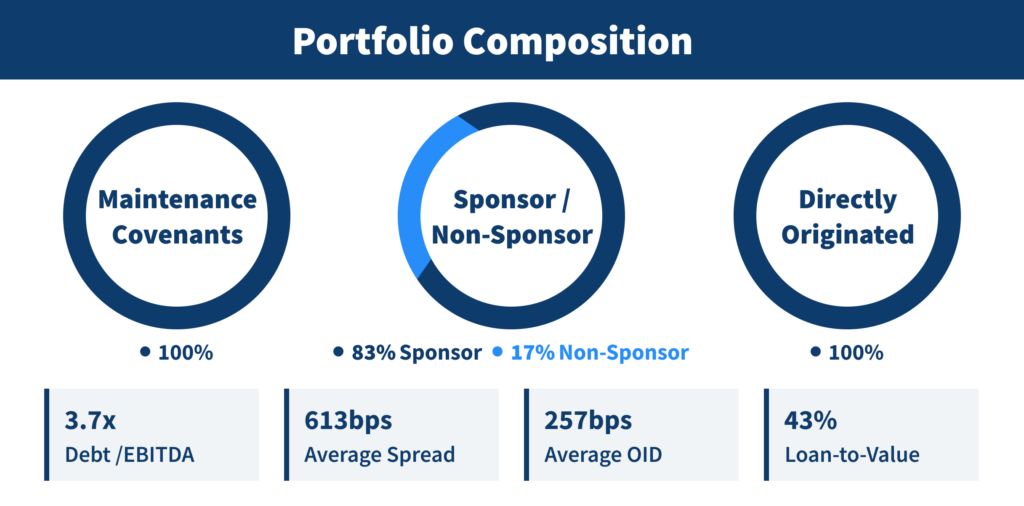
The result is a portfolio characterized by low average entry leverage (3.7x WhiteHorse EBITDA), conservative loan-to-value (at 43%), and no underperforming assets1.
In a market where return dispersion is widening, manager selection has never mattered more.

Pascal Meysson
Head of H.I.G. WhiteHorse Europe
Topics Covered in This Paper
This paper examines the structural divergence emerging across large-cap and upper middle market private credit and explains how H.I.G. WhiteHorse Europe’s positioning supports differentiated outcomes despite evolving market pressures and recent industry headlines.
- New Capital Pools are Changing Private Credit Incentives
- What Is Going Wrong in Large-Cap and Upper Middle Market Lending?
- Why These Trends Are Less Pronounced in the European Lower and Core Middle Market
- AI, Software Exposure, and Underwriting Discipline
- H.I.G. WhiteHorse Europe’s Core Direct Lending Principles
- Underwriting Credit with a Private Equity Lens
- Why Experience Matters in a Deep Credit Cycle
New Capital Pools are Changing Private Credit Incentives
Private debt has scaled rapidly, attracting capital from a broadening set of institutional and non-traditional sources. This is broadly positive for the asset class, but it has also introduced supply-demand dynamics that are not always aligned with credit performance.
For some managers, the economic emphasis has shifted toward asset gathering, with incentive fee structures reduced or eliminated. As deployment pressure increases, capital is being put to work more aggressively, often in more competitive segments, with looser documentation and weaker risk-adjusted returns. As return dispersion widens, we view alignment between manager economics and credit outcomes as critical to present and future investment performance.
These dynamics are most pronounced in the large-cap and upper middle market segments of the European private debt market. By contrast, lower and core middle market managers like H.I.G. WhiteHorse Europe, continue to operate predominantly through traditional LP/GP fund structures and SMAs, where alignment between capital deployment and credit performance remains intact. Capital deployment remains disciplined, with underwriting standards driven by durability rather than momentum.
Selectivity, not scale, drives outcomes.
For some managers, the economic emphasis has shifted toward asset gathering, with incentive fee structures reduced or eliminated … But selectivity, not scale, drives outcomes.
What Is Going Wrong in Large-Cap and Upper Middle Market Lending?
We believe the problems attracting negative headlines are real, but they are structural and segment-specific. Three issues stand out:
- Loss of Lender Control: Club structures have become the norm, leaving no single lender with decision-making authority. In an environment of excess liquidity, borrowers and owners have been able to favor structures that limit or dilute individual lender influence, to their benefit. While beneficial to borrowers and sponsors, this creates meaningful risk for lenders. In stressed or restructuring situations, fragmented control can lead to slower decision-making, weaker coordination, and materially lower recoveries.
- Covenant Erosion: In the upper end of the middle market, transactions are almost exclusively structured as cov-lite or carry covenant headroom so wide (45%+) that protections become largely cosmetic. Maintenance covenants are intended to provide lenders with the ability to intervene before value is irreparably impaired. When covenant headroom is excessively wide, lenders may only gain influence after equity value has already eroded and sponsors have limited incentive to support the business.
- Weakened Documentation: Beyond covenant structure, aggressive EBITDA adjustments, incremental leverage capacity, PIK flexibility, and restrictions on lender coordination appear to have become standard. Liability management exercises and lender-on-lender violence, once considered extreme, are now recurring features of the large-cap landscape. These are disturbing developments which we expect to ultimately lead to higher default rates and lower recoveries.
Structural Differences Across Private Credit Segments
| Large-Cap / Upper Middle Market | H.I.G. WhiteHorse Europe / Lower & Core Middle Market | |
|---|---|---|
| Covenant Structure | Cov-lite common | Maintenance covenants common |
| Lender Control | Fragmented clubs | Sole / controlling lender |
| EBITDA Adjustments | Aggressive | Conservative |
| Software Exposure | Significant | None |
| Documentation | Weakening | Negotiated |
| Average Leverage | 5–7×+ | 3.7x |
Why These Trends Are Less Pronounced in the European Lower and Core Middle Market
The lower and core middle markets operate differently. Transactions are predominantly bilateral. Borrowers do not have the luxury of running competitive processes among dozens of lenders, which means documentation quality is negotiated rather than dictated by market conditions. Underwriting standards are preserved through market cycles because discipline, not volume, drives performance.
At H.I.G. WhiteHorse Europe, this is reflected directly in how we structure every transaction. In our latest vintage fund, H.I.G. WhiteHorse Europe Direct Lending Fund II, 100% of our transactions carry maintenance covenants, with headroom systematically below 35%2. We act as sole lender in the majority of our transactions and hold a controlling position in virtually all others.
Beyond covenant structure, the documentation features that characterize the large-cap market are largely absent in this segment. Normalization adjustments are capped at reasonable levels, typically in the range of 10-20% of EBITDA. Our borrowers hao not have the ability to strip assets out of the borrowing group to extract additional leverage. PIK interest is limited to a small part of the coupon (typically up to 1-1.5%) for a defined period.
Because H.I.G. WhiteHorse Europe has monthly reporting, prioritizes covenants with meaningful protection, and other controls, we can identify potential underperformance early and engage constructively before situations become critical. We believe these structural features, combined with the strong H.I.G. underwriting culture, have allowed us to minimize defaults, maximize recoveries and ultimately produce attractive risk-adjusted outcomes3.
The lower and core middle markets operate differently… Underwriting standards are preserved through market cycles because discipline, not volume, drives performance.
AI, Software Exposure, and Underwriting Discipline
The software sector highlights how underwriting discipline drives divergent outcomes.
Over the past decade, many lenders, particularly those focused on the large-cap and upper middle market, loosened underwriting standards in software transactions, operating under the assumptions that revenues would remain sticky, recurring, and highly defensible. As a result, leverage multiples expanded from 5-6x EBITDA to 7x-10x EBITDA, and annual recurring revenue (ARR) multiples increased from 1.5x -2.5x to 3x-4.5x, and, in some cases, lending extended to companies without positive EBITDA.
H.I.G. WhiteHorse Europe assessed a number of these opportunities but found them consistently characterized by elevated leverage, aggressive assumptions, rushed due diligence, and weak documentation. We were also reluctant to lend on an ARR basis, as it did not align with our culture of credit underwriting. As a result, we chose not to participate.
Today, H.I.G. WhiteHorse Europe has zero exposure to software.
In retrospect, that discipline preserved capital and investment integrity, outcomes that have proven advantageous in the face of increasing disruption from AI, evolving business models, and valuation pressure.
While we do not view software as uninvestable, future participation will remain selective and driven by conservative structures and risk-adjusted returns.
Today, H.I.G. WhiteHorse Europe has zero exposure to software. While we do not view software as uninvestable, future participation will remain selective and driven by conservative structures and risk-adjusted returns.
H.I.G. WhiteHorse Europe’s Core Direct Lending Principles
We focus exclusively on directly originated loans in the lower and core middle market, underwritten to hold.
This model can provide structural advantages:
Full control over documentation and covenant frameworks
Bilateral negotiation rather than widely syndicated processes
Direct access to management and sponsors
Deeper diligence and ongoing visibility
Greater influence in periods of stress
Performance is ultimately driven by borrower cash flow, not technical market dynamics. Unlike larger segments, where capital markets generally influence pricing and behavior, our segment remains anchored in fundamental credit underwriting.
Underwriting Credit with a Private Equity Lens
Our underwriting philosophy mirrors H.I.G.’s private equity standards. Investments undergo independent quality-of-earnings analysis, comprehensive financial diligence, commercial diligence, competitive positioning assessment, and detailed cash flow modeling under stressed conditions. Management evaluations and legal diligence further reinforce our credit selection process. We do not make blind “sponsor bets.”
A key differentiator is our treatment of EBITDA. While market participants often rely heavily on sponsor-provided “Adjusted EBITDA”, which often incorporates add-backs, synergies, cost savings, and forward-looking initiatives, we apply a conservative, independent assessment of recurring earnings (“H.I.G. WhiteHorse EBITDA”). This frequently results in higher effective leverage than marketed, but ensures underwriting is anchored in real cash flow, not projections.
Why Experience Matters in a Deep Credit Cycle
There has not been a deep credit cycle in 17 years. This is a market anomaly. A range of potential catalysts, including AI disruption, geopolitical instability, energy inflation, and broader macro tensions, could each independently trigger a meaningful downturn. Many private market participants operating today have never invested through a full credit cycle. This is particularly relevant in credit, where outcomes are defined by downside protection. At H.I.G. WhiteHorse Europe, all eight Investment Committee members were active investors through the Global Financial Crisis. We view this experience as a critical differentiator in the current environment.
In a severe downturn, outcomes across private credit are likely to diverge meaningfully by segment.
Large-cap and upper middle market borrowers benefit from scale, diversification, and access to capital. However, their capital structures and documentation introduce structural vulnerabilities. Leverage is often presented in the 5–7x range, but on a more conservative, unadjusted basis, can be materially higher. In a downside scenario, even a modest 10–20% decline in EBITDA could push leverage to levels where equity is effectively out of the money. In cov-lite structures, lenders may have limited ability to act until a payment default occurs. By that point, sponsors may have little incentive to inject additional capital, and control is often fragmented across lender groups. In our experience, this dynamic can lead to delayed interventions, lower recoveries, and more complex restructurings.
The lower middle and core middle market segments are not immune from a deep cycle. Smaller companies are inherently more sensitive to economic cycles. However, the structural characteristics of this segment, including lower leverage, tighter documentation, and lender control, can meaningfully influence outcomes.
Using our own platform as an example, average entry leverage in our latest vintage is 3.7x, against an average entry EV multiple of approximately 9x EBITDA – based on a conservative H.I.G. WhiteHorse EBITDA. In a severe downside scenario, assuming a 30–40% decline in earnings, leverage would increase to approximately 5.3x–6.2x. While elevated, these levels would typically remain within enterprise value, even under valuation compression. More importantly, our maintenance covenants would breach on average at 5x leverage or below, providing the opportunity to engage while sponsors/owners remain economically incentivized to support the business. In this context, recapitalizations and constructive restructurings are more likely.
In a GFC-type environment, private credit as a whole would experience stress. However, we believe that the European lower and core middle market is structurally better positioned to withstand a deep cycle, with a greater ability to intervene early, minimize defaults, and maximize recoveries relative to the more competitive large-cap and upper middle market segments.
Many private market participants operating today have never invested through a full credit cycle. This is particularly relevant in credit, where outcomes are defined by downside protection.
Conclusion
Private credit is not a monolithic asset class. The risks highlighted in recent headlines are real, but we believe they are concentrated in specific segments of the large-cap and upper middle market, driven by excess liquidity, misaligned incentives, and structural erosion.
Lower and core middle market direct lending operates under a fundamentally different model, defined by negotiated documentation, lender control, conservative leverage, and discipline in underwriting.
No strategy is immune to market dislocation or economic cycles, but starting conditions matter. We believe our positioning – control-oriented structures, conservative underwriting, and a focus on cash flow durability – places H.I.G. WhiteHorse Europe in a structurally advantaged position to navigate dislocation, protect capital, and deliver consistent income through the cycle, offering institutional investors a resilient and deliberately differentiated allocation within private credit.
Sources
Figures presented herein reflect those of H.I.G. WhiteHorse Europe Direct Lending Fund II. Past performance is not indicative of future results. Additional details regarding H.I.G. WhiteHorse Europe Direct Lending Fund II are available upon request. It should not be assumed that market trends will continue. This communication does not constitute an offer or solicitation to subscribe for or purchase any interest in any fund managed by H.I.G. Capital and its affiliates. Any offering of interests will occur only in accordance with the terms and conditions set forth in the relevant fund’s private placement memorandum
- Net Leverage and Net LTV: As of 3/31/2026. Based on cumulative capital invested.
- Direct vs. Indirect, Covenants at Entry, Sponsor / Non-Sponsor, Average Spread and OID: As of 3/31/2026. Percentages based on cumulative capital invested for entire portfolio.
- Refers to European direct lending investments made by the H.I.G. WhiteHorse platform since 2013.